
Muse Image: Why Meta’s new AI feature only lasted 72 hours
TORONTO, ON –
Consent, likeness, and AI exploitation
Meta launched Muse Image, a new AI image generator that was integrated into Meta-owned Instagram, WhatsApp, and the Meta AI app, on July 7, 2026. The feature quickly became a major controversy because it allowed anyone to tag a public Instagram account and generate AI images using those public photos by default.
By July 10, Meta announced it was suspending the feature after backlash from creators, unions, talent agencies, and privacy advocates.
Diverge helps artists, creators, and influencers protect their work, negotiate smarter, and build their business without giving up control of the value they create.
The suspension is an important result, but it does not erase the core problem: the original design treated public content and identity as available raw material for AI generation unless the user actively said no.
For creators, artists, influencers, public personalities, and talent-led brands whose professional visibility depends on maintaining a public-facing account, the controversy around Muse AI highlighted an especially important flashpoint for consent, likeness rights, and exploitation.
Without proper regulation in place to restrict this type of unilateral platform behaviour, we’re likely to see a resurgence of this opt-out model if platforms roll out similar features under different names in the future.
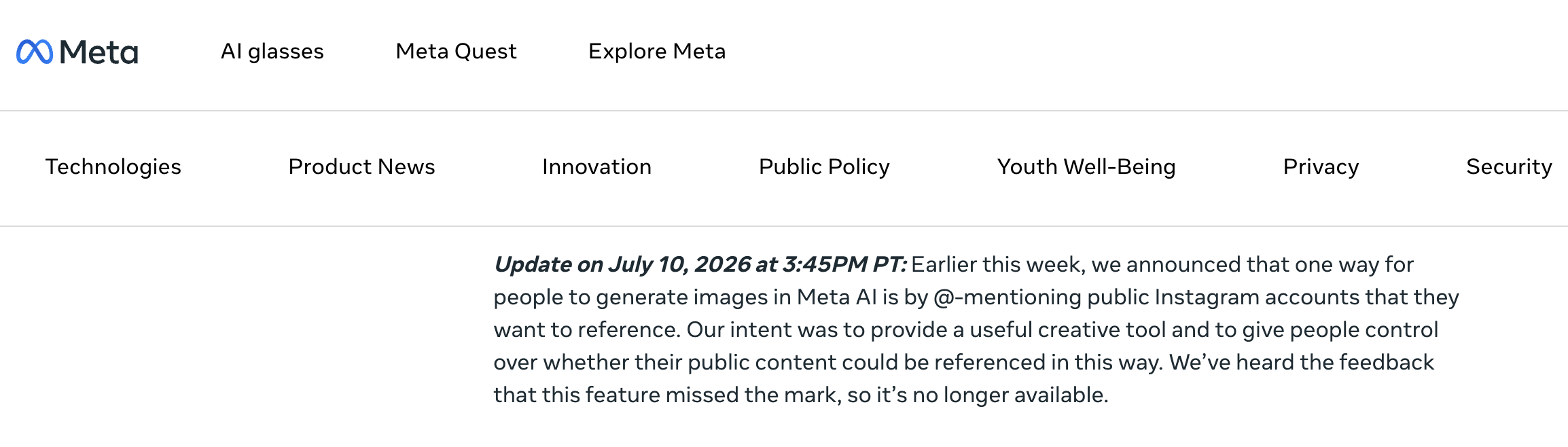
After announcing Muse Image on July 7, Meta updated its website on July 10 to remove the unpopular feature from the product description.
What Muse Image actually did
Prior to disabling the feature, Muse Image was Meta’s first standalone image-generation model, built by Meta Superintelligence Labs and rolled out across the Meta AI app, Instagram Stories, and WhatsApp. The feature allowed any user to tag or reference a public Instagram account inside an AI prompt, pulling that account’s public photos, Reels, and content into the AI image-generation process to create new, AI-remixed images.
Essentially, Meta built a feature that treats a person’s public content and identity as available raw material for AI generation unless that person take affirmative action to say no, and Meta did so without seeking individualized consent, without offering compensation, and without a mechanism to undo past misuse.
The structural problem is that an opt-out model presumes permission, while an opt-in model requires it. Every serious critic of Muse Image, from CAA to SAG-AFTRA to privacy researchers, converged on the same conclusion. CAA in particular, framed this as a matter of basic autonomy, arguing that no one’s name, image, likeness, voice, or creative work should be used by any third party, including AI models, without clear, documented permission.
Why Meta’s public response wasn’t enough to keep the feature live
In response to public backlash over privacy concerns and content exploitation, Meta issued a statement on July 9, just two days after its release and one day prior to its suspension, defending the feature.
Meta’s statement assured users that Muse Image was built “with strong controls and safety guardrails from day one,” that private accounts and users under 18 were excluded by default, and that adult users with public accounts “can opt out with just a couple of clicks.”
Although users with public accounts would have been able to change settings to disable future reuse, the default structure was opt-out, not opt-in, and Meta’s help materials indicate that users would not necessarily be notified when AI content featuring their likeness was created using Muse Image.
By requiring users to locate a non-obvious setting buried under “Sharing and Reuse” in order to prevent AI use of their public content (or in some cases, manually opt-out on individual posts), Meta placed the responsibility for prevention on platform users rather than on itself. For creators managing a growing platform, negotiating brand deals, and posting frequently, discovering and disabling a setting after the fact is not a substitute for being asked first, especially since the setting reportedly did not work retroactively. That meant that any AI-generated content already created using a public account’s photos before the user disables the setting can remain in circulation.
Although discontinuing the Muse Image feature is the responsible thing to do, disabling it does not fix these problems either. It just removes the feature from the marketplace for now while leaving the underlying logic intact.
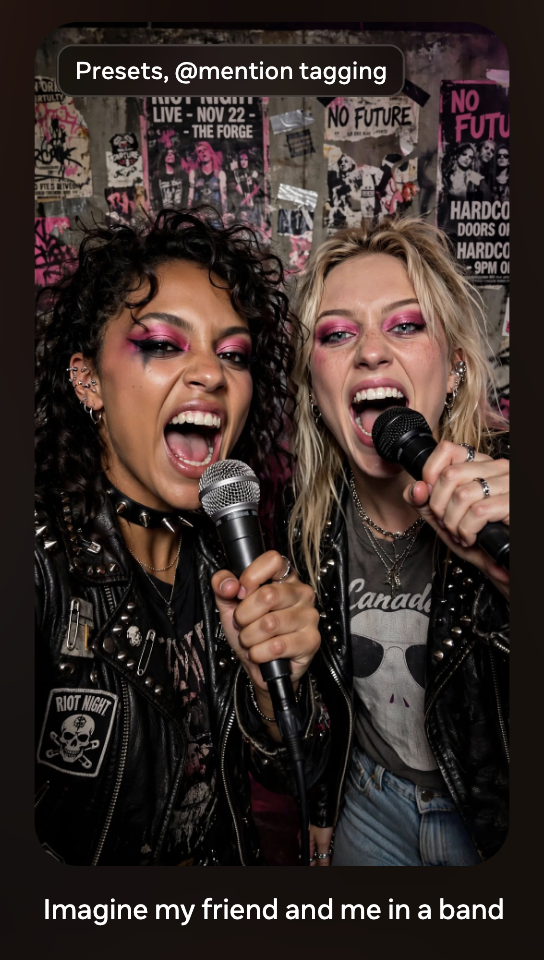
From Muse AI’s website demo: “With @mentions and saved references, you can easily create personalized birthday cards, inside jokes, and other fun images.”
Creator livelihood and commercial exploitation
Meta’s framework wrongly assumed that if an account is public, its content is fair game unless the user says otherwise. For ordinary users, this assumption was already questionable. For creators and public personalities, whose assets often represent their livelihood, the assumption is plainly exploitative. Creator accounts are functionally required to be public for professional visibility, brand deals, and discoverability, meaning the ability to simply “go private” offered no real recourse.
A creator’s face, voice, name, signature look, recurring format, and visual identity are often the most valuable business property they have, because that identity is what audiences recognize, what brands pay for, and what turns content into a monetizable business. As a result, creators are the group most pressured to stay public in order to remain discoverable, commercially viable, and relevant on a social platform.
When a platform unilaterally makes a creator’s likeness available for AI-enabled remixing or generation by others without individualized consent, artist attribution, adequate compensation, an opportunity to negotiate licensing terms, or even notice of AI use, it is not merely launching a feature. It’s taking a creator’s primary business asset and making it available for platform-facilitated exploitation.
If brands, advertisers, or other users can generate derivative AI content using the public identity of creators whose careers depend on exclusivity, recognizability, and trust, the platform is effectively widening access to the very thing that gives those creators market value. When that happens without notice, compensation, attribution, or clear consent, the result is not only a rights issue but a transfer of commercial value away from the creator and toward the platform ecosystem.
Meta’s public response was notably silent on whether businesses could use Muse Image to generate promotional content referencing a public creator’s account without that creator’s direct involvement. However, if brands or other commercial actors can tag a creator’s public account and generate AI imagery associated with that creator’s identity, then any safety guardrails around “policy-violating content” referenced by Meta would have still failed to resolve the more basic question of whether that use was authorized at all.
The problem with (the lack of) consent
Using someone’s image, voice, or likeness should always require express consent that is freely given, clearly documented, and obtained in advance—not assumed by default and revocable only after the fact. In Meta’s case, the idea that automatic opt-in is a robust form of consent is weak on its own, but it’s further weakened by the fact that previously generated AI content may remain even after a user later disables the setting.
In theory, a public user who can toggle settings off or switch the account to private may seem reasonable. For many creators, switching to a private account undermines the discoverability, reach, archived content visibility, and community access that the creator spent years building on the platform. The choice to remain opted into a system that enables AI use of public content and likeness, or go private is hardly a choice.
That dynamic creates a coercive trade-off. Creators already face high risks around intellectual property threats like content theft, impersonation, false association, unauthorized endorsements, and likeness misuse. The consent model behind Muse Image was especially dangerous because it placed creators in the impossible position of having to either accept the risk of a new, automated pathway for misuse onto an already fragile vulnerability or walk away from the audience, content library, and business infrastructure they built through years of unpaid platform labour. That is not meaningful autonomy. It is a take-it-or-leave-it system in which the platform keeps the upside of creator visibility while the creator bears the downside of dilution, misuse, and loss of control.
The fact that Meta suspended Muse Image within days does not change that analysis. It shows how quickly the backlash moved, but it also confirms that the launch was a serious misstep in how the public views consent and the use of their identity in AI tools.
What this means for the creator economy
Public creators are disproportionately exposed to impersonation, unauthorized endorsement, and reputational damage from AI-generated content bearing their likeness. Meta’s own design decisions made that exposure automatic rather than optional for the population most likely to be affected by it.
For creators who depend on public visibility to run their business, the Muse Image launch left a narrow and unfair set of choices: stay opted in and accept that public content may be used to generate AI imagery associated with their identity, or attempt to lock down settings and hope the fix works retroactively, which reporting confirms it does not.
Platforms may pull features when backlash hits, but they can also relaunch similar tools with slightly different settings and wording. Creators should not rely on the idea that a platform will “do the right thing” when the pressure is on.
Neither choice in the immediate Muse Image scenario reflected meaningful consent. And neither choice should be treated by creators, brands, or platforms as sufficient legal protection going forward.
Until platforms move to genuine opt-in models with clear compensation structures, creators need to treat likeness protection as a matter they control directly, not one they can outsource to platform settings. That means documenting original content, monitoring for unauthorized AI use of one’s image, and building explicit AI and likeness protections into brand deals and contracts so that platform gaps do not become the creator’s problem to solve alone.
As platforms continue to build AI features faster than they build consent frameworks, creators need advisors who can translate these gaps into practical protection. Diverge Legal helps creators, artists, and talent-led brands respond to exactly this kind of platform risk.
If you’re ready for representation that cares about protecting what you’re building, contact us.
Read these next

More about DIVERGE
Diverge is not just a legal service provider. We’re your partner in building a legally sound and sustainable content creation business. We understand the unique challenges creators face and offer tailored solutions to protect your intellectual property, ensure regulatory compliance, and minimize legal risks.
Whether you’re an established influencer or an emerging creator, Diverge is here to help you focus on what you do best, while we take care of the legal complexities.
Reach out to Diverge today to learn more about how we can support your content creation journey.
Follow @diverge.legal on social media or subscribe to our newsletter below for more tips on protecting your creative rights and thriving in the creator economy.
Important Notice: The information in this article is provided for general informational purposes only and is not intended as legal advice. Reading this content does not create a lawyer-client relationship. Always seek professional legal counsel tailored to your specific situation. No part of this article may be reproduced or transmitted, in any form or by any means, electronic, mechanical, photocopying, recording or otherwise, or stored in any retrieval system of any nature, without the express written permission of Diverge Legal.
